


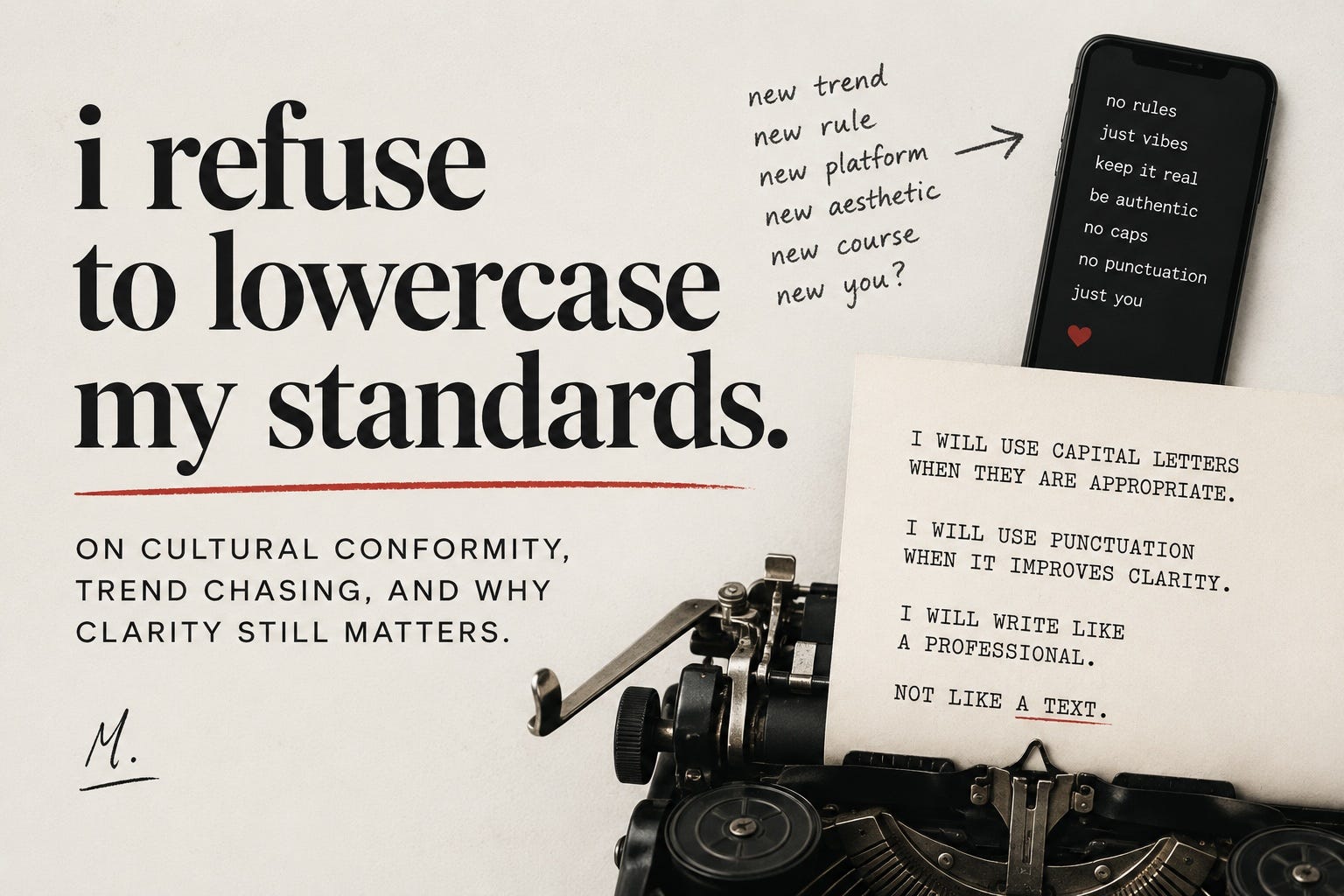
Somewhere along the way, headlines stopped being headlines and started looking like half-finished text messages.
All lowercase. No punctuation. No structure…just vibes.
Apparently this is the new way to signal that you are modern, cool, relevant, tech-forward, creator-native, platform-savvy, culturally fluent, stylistically minimal, algorithmically blessed, and whatever else this week’s buzzword generator spits out.
I think it’s ridiculous.
Not because lowercase is immoral. Not because language must be rigid. But because this particular shift feels less like evolution and more like submission. Submission to the idea that we must constantly contort ourselves to match whatever tiny aesthetic twitch Silicon Valley or social media decides will keep the engagement machine humming.
Rules exist for a reason. Capitalization is not oppression. Grammar is not a relic. Structure is not elitism. It is clarity. It is signal. It is respect for the reader.
And yet we are told, implicitly or explicitly: If you want to be seen, soften your voice. Flatten your authority. Look casual. Look frictionless. Look like you are not trying too hard, even if you are trying harder than ever.
Do this to be cool.
Do this to be relevant.
Do this to matter.
Do this so the algorithm smiles upon you.
It begins to feel less like publishing and more like high school cafeteria politics, where success depends on sitting at the right table, wearing the right thing, using the approved slang, and pretending you are not desperate to belong while performing that sense of belonging with almost Olympic intensity.
I thought we graduated.
What frustrates me most is not the lowercase letters themselves. It is the constant churn. The never-ending carousel of micro-trends designed to keep creators, professionals, and businesses slightly off balance. Never comfortable. Never settled. Always wondering if they are doing it wrong now.
This is not really about capitalization at all. What I am talking about here is cultural conformity disguised as innovation.
To be clear, not every change is a bad one. Some shifts genuinely improve communication, readability, or accessibility. The problem begins when we stop asking whether something is useful and start adopting it simply because everyone else is doing it.
Because if you are uncertain, you are pliable and If you are pliable, you are profitable.
A new tool appears, then a new platform, then a new formula, followed by a new rule, a new subscription, and inevitably a new course promising to teach you how to follow the rule you did not even know existed yesterday.
“Oh look, a new thing.”
“Quick, change everything.”
“Stay relevant.”
“Don’t get left behind.”
It is exhausting.
Meanwhile, the world outside our screens feels increasingly unstable, complicated, and uncertain, with real problems demanding real attention, yet somehow we are being nudged to worry about whether our headlines look casual enough to please an algorithm. It is a strange moment in history when global instability, economic anxiety, and genuine human concerns coexist with the pressure to appear effortless, soft, and perpetually online, as if projecting the right aesthetic might matter more than saying something meaningful. The contrast is hard to ignore: serious times, unserious expectations.
And frankly, that is not how real credibility is built …well, at least not the kind of credibility I recognize from years of experience, both professionally and simply from living in the real world. True credibility does not come from shape-shifting to match every passing fashion or scrambling to decode the latest unspoken rule of the internet. It is earned slowly through consistency, through substance, through having a clear voice that people learn to trust over time. It comes from showing up the same way when no one is watching as when everyone is, from standing on something solid rather than chasing whatever stylistic breadcrumb trail tech culture happens to scatter in a given quarter.
If your ideas are strong, you do not need to whisper to be heard.
If your work has value, it does not need to cosplay as casual to be trusted.
If your audience respects you, they are not counting your capital letters.
I am not interested in flattening my voice to match an aesthetic mood board. I am not interested in performing “effortless” while quietly burning hours second-guessing whether my typography is sufficiently cool. And I am certainly not interested in returning to the emotional logic of high school, where the fear of not fitting in drives every decision.
At this stage in our lives, many of us are running businesses, leading teams, and producing work that carries real weight, so it is hard to justify stepping back into what amounts to a popularity contest disguised as aesthetic preference.
So no, I will not lowercase my standards to lowercase my headlines.
I will use capital letters when they are appropriate.
I will use punctuation when it improves clarity.
I will write like a professional, not like I am texting from the back row of algebra class.
If that makes me unfashionable, so be it.
And if refusing to chase every tiny stylistic swing makes me less “relevant,” I am perfectly comfortable with that. Because the people who resonate with my words or find comfort in them are likely connecting because they recognize something genuine in them, not because I am bending my language to fit the latest trend.
Because relevance built on trend compliance is not relevance. It is a dependency.
So consider this my opt-out.
I refuse.
-M

Insightful and powerful!